Neural activity during social behavior in freely moving animals.
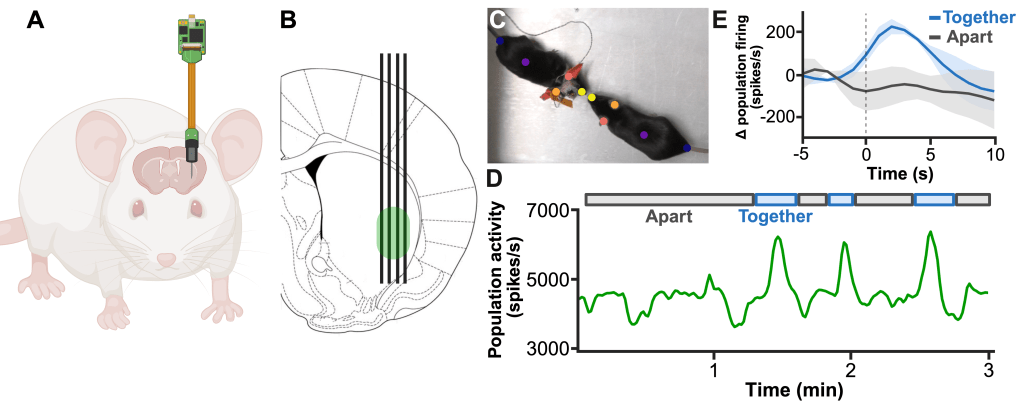
Neural population activity during social interaction. (A) Cartoon illustrating Neuropixels probe implantation in freely behaving mice. (B) Recording location within the striatum. Green highlights the area of the probe that was recording neural activity. (C) Two mice are tracked using markerless pose estimation (DeepLabCut). (D) Population neural activity recorded across a behavioural session, aligned with periods when animals are interacting (“together”) or separated (“apart”). (E) Average change in firing rates aligned to the onset of social interaction, showing increased neural population activity when mice engage socially.
Using machine learning to track and measure social and non-social behaviors.
To understand animal behavior, I employ a combination of manual scoring and machine learning-based tracking to capture fine-grained details of movement and interaction. Using tools like DeepLabCut, I can precisely track body positions, postures, and multi-animal interactions across a variety of social contexts. This approach allows me to quantify the subtleties of social play, aggression, and socio-sexual behavior, revealing how neural activity maps onto naturalistic social dynamics.
For more on this, see Ham et al. 2024. To read the full text, click here.
A wild macaque engage in stone ponding.
Raw video courtesy of Dr. Jean-Baptiste Leca.
Neural circuits of emotional control.
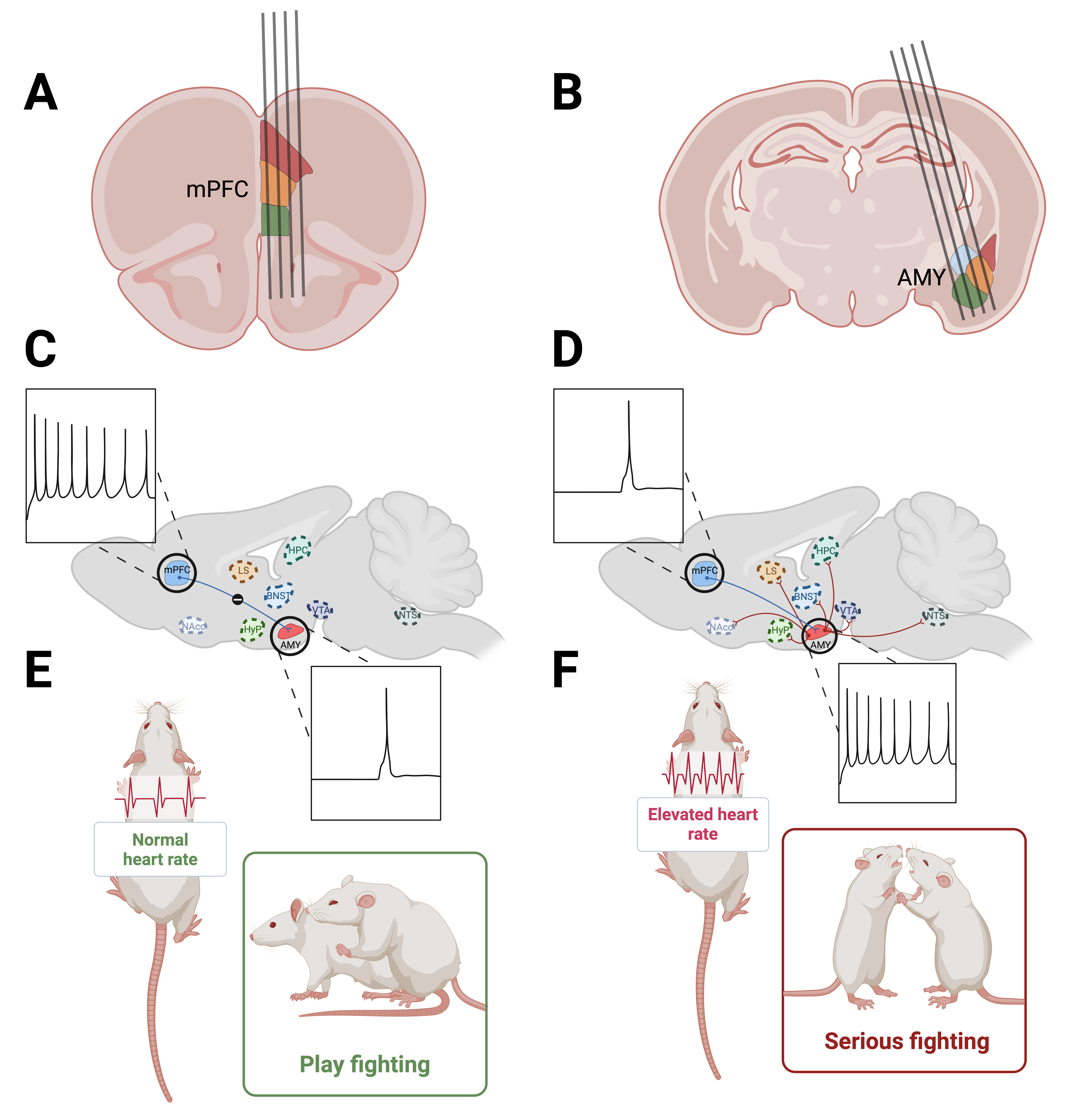
How does the brain keep emotions in check during social encounters — and what happens when that system goes awry? Our research investigates how neural circuits between the medial prefrontal cortex and the amygdala enable animals to balance playfulness, aggression, and emotional control. Using Neuropixels 2.0 electrophysiology and wireless telemetry in freely behaving rats, we record real-time brain and physiological activity as animals engage in both social interactions and non-social challenges. By comparing animals that experience typical juvenile play with those deprived of it, we aim to uncover how early-life experiences shape the brain’s ability to regulate emotion across contexts. This work bridges behavioral neuroscience, physiology, and advanced neurotechnology to reveal how play builds resilient brains — and to provide insights into disorders like anxiety, ADHD, and autism, where emotional regulation is disrupted.
How early life experiences shape brain development and adult behavior.
A key line of my research explores how the quality of juvenile play — particularly its reciprocity and balance — shapes brain development and social competence. In rats, I’ve shown that deficient or unbalanced play leads to structural changes in the medial prefrontal cortex and lasting deficits in sociocognitive skills, highlighting how meaningful social experiences fine-tune neural circuits for emotional regulation.
Individual differences and the development of social competency.
Even when social play is abundant, not all individuals gain the same developmental benefits. In this line of research, we examined rats reared in large, play-rich social groups and found that about 20% still developed poor social competence as adults, often escalating playful encounters into aggression. Despite comparable juvenile play frequency, these “incompetent” rats showed excessive dendritic growth and reduced pruning in medial prefrontal cortex neurons — the same neural signature seen in play-deprived animals. These findings reveal that some individuals fail to translate play experience into socio-cognitive skill, suggesting intrinsic or early-life factors shape how effectively play sculpts the social brain.
Social decision making and play partner preferences in rats.
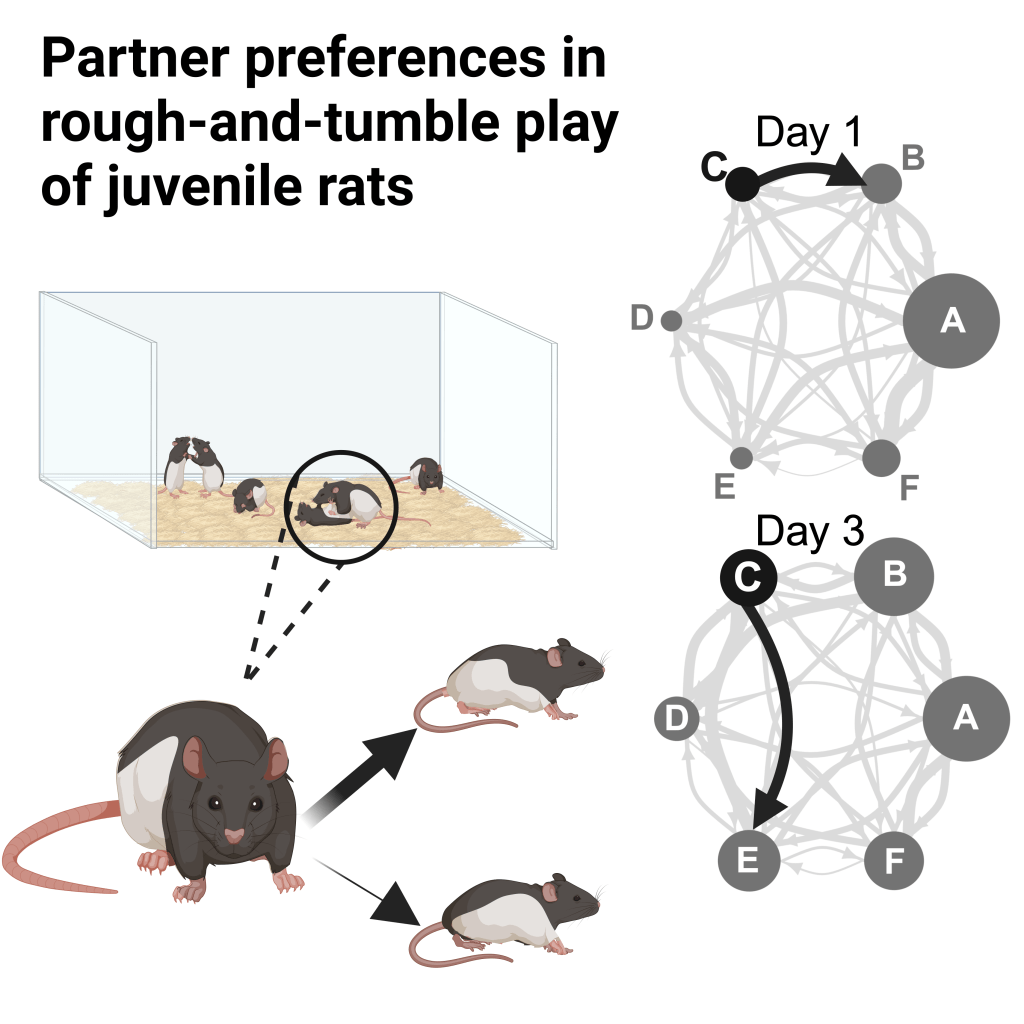
This line of research explores how young animals choose their social partners and how familiarity, novelty, and group context shape the dynamics of play. Across several studies, I’ve shown that juvenile male rats balance between familiar and unfamiliar partners — preferring a “just right” level of novelty that promotes engagement and learning. These partner preferences shift depending on group size and social composition, emerging in group settings but not in isolated pairs, and often becoming unstable even among familiar cage mates. Together, this work demonstrates that social play is a context-dependent and dynamic process, offering insights into how animals regulate social motivation, recognize individuals, and build the cognitive skills that underlie complex social behavior.
Influence of social stability on cognitive decline and memory in a mouse model of Alzheimer Disease.
This line of research investigates how social network stability influences cognition, mood, and brain health in aging and dementia. Using mouse models of Alzheimer’s disease and natural aging, I simulate the social disruption individuals often experience after moving into care facilities, where long-term social ties are lost. Through behavioral assays, in vivo electrophysiology, and metabolomic analysis, I examine how social instability alters neural activity in the hippocampus and amygdala, leading to changes in memory, emotional regulation, and inflammation. Early findings suggest that stable social networks protect against cognitive and mood decline, offering biological insight into how social isolation accelerates dementia progression and highlighting the importance of social connection in healthy aging.
Supported by:


 Jackson R. Ham